What vehicles can you drive with a UK driving licence? The letters and numbers on the back of your photocard tell you whether you can drive a car, motorcycle, van, motorhome, minibus, lorry or vehicle towing a trailer. They also show any restrictions you must follow.
For example, category B covers most cars, category BE covers cars towing trailers, category C1 covers medium-sized vehicles and category D1 covers minibuses. However, the vehicles you can legally drive depend on your individual entitlements, when you passed your test and any restriction codes.
This guide explains UK driving licence categories and codes, including the current towing rules, automatic-only licences, older licence entitlements and how to check your DVLA driving record online.
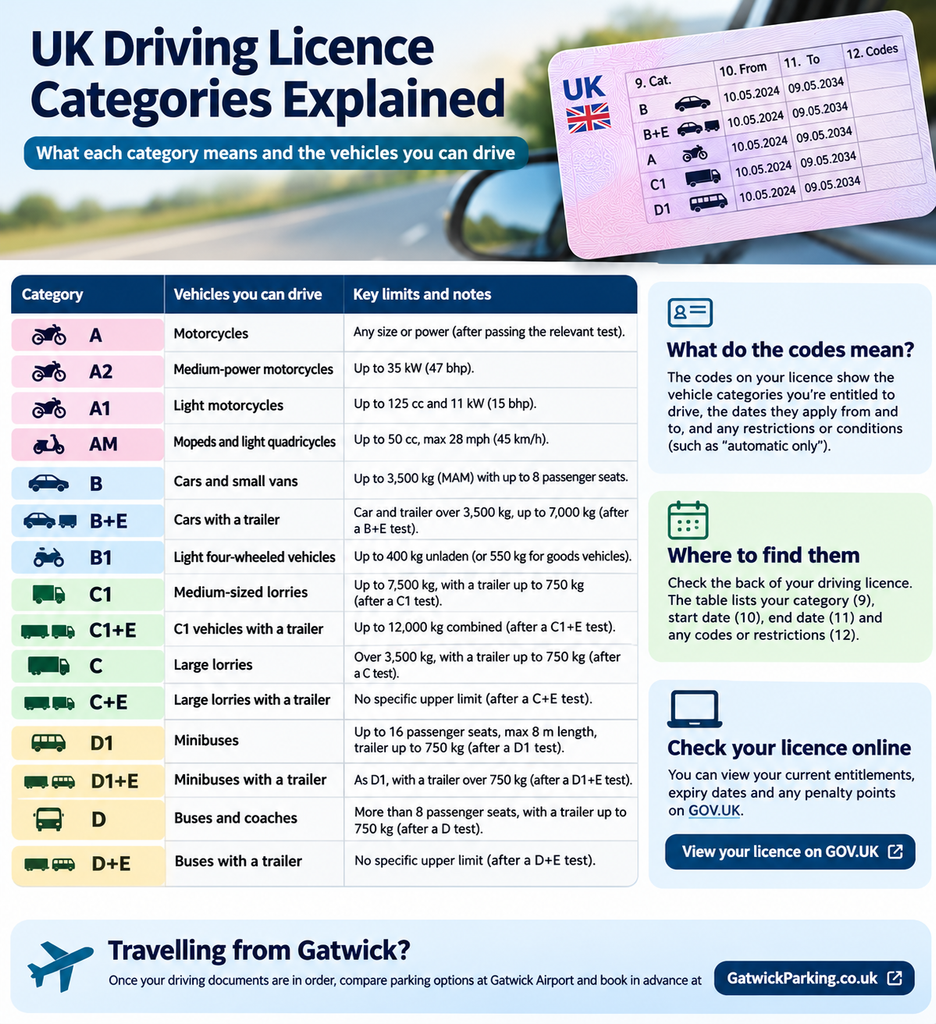
UK driving licence categories at a glance
| Category | Vehicles covered | Key limits |
|---|---|---|
| AM | Mopeds and light quadricycles | Generally over 15.5mph and up to 28mph |
| A1 | Light motorcycles | Up to 125cc and 11kW |
| A2 | Medium-power motorcycles | Up to 35kW, subject to power-to-weight limits |
| A | Motorcycles | Unrestricted motorcycle entitlement |
| B | Cars and small vans | Generally up to 3,500kg MAM for petrol, diesel and hybrid vehicles; different limits for eligible zero-emission vehicles |
| B auto | Automatic cars | Automatic transmission only |
| BE | Cars with trailers | Trailer limits depend on the entitlement date |
| B1 | Light four-wheeled vehicles | 400kg unladen, or 550kg for goods vehicles |
| C1 | Medium-sized vehicles | Over 3,500kg up to 7,500kg MAM |
| C1E | C1 vehicles with trailers | Combined MAM up to 12,000kg, subject to restrictions |
| C | Large lorries | Over 3,500kg MAM |
| CE | Large lorries with trailers | Category C vehicles towing trailers over 750kg |
| D1 | Minibuses | Up to 16 passenger seats, maximum length 8 metres |
| D1E | Minibuses with trailers | Combined MAM up to 12,000kg |
| D | Buses and coaches | More than eight passenger seats |
| DE | Buses with trailers | Trailers over 750kg |
| f | Agricultural tractors | Additional road-use requirements apply |
| G | Road rollers | Specific entitlement and operating requirements |
| H | Tracked vehicles | Specific entitlement and operating requirements |
| k | Pedestrian-controlled vehicles | Includes certain mowing machines |
| p and Q | Specified low-speed vehicles | Speed, engine and vehicle-type restrictions apply |
Important: This table summarises vehicle categories, not the entitlements automatically held by every driver. Some categories require additional tests, medical checks or minimum ages. Always check your personal DVLA record before driving an unfamiliar vehicle.
Check which vehicles you can drive using the official DVLA service.
Where are driving licence categories and codes shown?
On a Great Britain photocard driving licence, the vehicle entitlement table is printed on the reverse.
- Column 9: Vehicle categories you are entitled to drive.
- Column 10: Date from which the entitlement is valid.
- Column 11: Expiry date for that category.
- Column 12: Restriction codes or conditions that apply.
Check all four columns together. A category may appear on your licence but have an expiry date or restriction that affects whether you can currently use it.
What can you drive with a category B licence?
Category B is the standard car driving licence category. For drivers who passed their test on or after 1 January 1997, it generally permits vehicles with up to eight passenger seats and a maximum authorised mass (MAM) of 3,500kg for petrol, diesel and hybrid vehicles.
Under the current DVLA category rules, eligible zero-emission electric and hydrogen vehicles can have a higher MAM of 4,250kg. A further allowance may apply for equipment used to carry disabled passengers. Check the official rules and your entitlement before relying on a higher limit.
Category B can cover cars, small vans, some motorhomes and certain other vehicles. The vehicle must meet the relevant weight, seating and licensing conditions.
What is maximum authorised mass (MAM)?
Maximum authorised mass is the maximum permitted weight of a vehicle or trailer when fully loaded. It is sometimes called gross vehicle weight.
For licensing purposes, the plated maximum weight matters, not just how much the vehicle weighs on the day.
For example, a van with a MAM of 4,000kg does not become a category B vehicle simply because it is currently carrying a light load.
Can you tow a caravan or trailer with a category B licence?
Yes. Drivers with a full category B licence can generally tow a trailer without taking a separate car-and-trailer driving test. The rules changed on 16 December 2021, when eligible drivers automatically gained category BE entitlement.
For drivers who gained BE entitlement on or after 19 January 2013, the trailer can have a MAM of up to 3,500kg, subject to the towing limits of the vehicle.
Drivers with older BE entitlements may have different trailer weight limits. Check the BE valid-from date on your licence.
DVLA may add the BE category to your physical photocard when it is next renewed. You can check your current entitlement online without waiting for a replacement card.
Remember: Having the correct driving licence does not mean your car can safely or legally tow every trailer. Check the manufacturer’s towing capacity, the trailer’s plated weight, loading requirements and any other applicable rules.
Official guidance: Towing with a car – GOV.UK.
What is the difference between category B and BE?
Category B is the main car entitlement. Category BE relates to a category B vehicle towing a trailer.
Although BE entitlement is now normally granted automatically when you pass the category B car test, the permitted trailer weight still depends on the applicable rules and your entitlement date.
What does category B auto mean?
Category B auto allows you to drive category B vehicles with automatic transmission only.
If you passed your practical driving test in an automatic car, you cannot drive a manual car using that entitlement. To gain full manual entitlement, you normally need to pass a practical test in a manual vehicle.
Automatic-only restrictions are commonly identified by driving licence code 78.
What is category B1 on a driving licence?
Category B1 covers certain light four-wheeled motor vehicles weighing up to 400kg unladen, or 550kg if designed to carry goods.
It can appear on older driving licences. Whether you can drive a particular quadricycle depends on its classification and the entitlements shown on your licence.
What can you drive if you passed your test before 1997?
Drivers who passed their car driving test before 1 January 1997 often have additional entitlements sometimes described as grandfather rights.
These may include permission to drive medium-sized vehicles, certain minibuses and heavier vehicle-and-trailer combinations without having taken the additional tests now required of newer drivers.
For example, older entitlements may include:
- C1: Vehicles over 3,500kg and up to 7,500kg MAM.
- C1E with code 107: Certain vehicle-and-trailer combinations up to 8,250kg MAM.
- D1 with code 101: Certain minibuses, restricted to non-commercial use.
These rights are not identical for every licence holder. They may also change when the driver reaches 70 or renews certain categories.
What is category C1 on a driving licence?
Category C1 permits vehicles with a MAM over 3,500kg and up to 7,500kg, with a trailer weighing up to 750kg MAM.
This is particularly relevant for people driving larger vans, some motorhomes and other medium-sized vehicles.
If you passed your car test on or after 1 January 1997, you will generally need to obtain the appropriate provisional entitlement and pass the relevant test to gain C1.
What is category C1E?
Category C1E allows a category C1 vehicle to tow a trailer over 750kg MAM, with a combined vehicle-and-trailer MAM of up to 12,000kg.
Some older licences include code 107, which restricts the combined MAM to 8,250kg.
Can you drive a motorhome with a standard car licence?
Many motorhomes can be driven with a category B licence, provided they fall within the relevant weight limits.
For conventional petrol or diesel motorhomes, the usual category B limit is 3,500kg MAM. A heavier motorhome may require category C1 or another appropriate entitlement.
Before driving a motorhome, check its plated MAM, your licence categories and any applicable restrictions. Do not rely on the vehicle’s empty weight or its advertised number of berths.
What are categories C and CE?
Category C: Allows you to drive vehicles over 3,500kg MAM with a trailer up to 750kg MAM.
Category CE: Allows you to drive category C vehicles with a trailer over 750kg MAM.
These categories are primarily associated with large goods vehicles. Additional tests, medical standards and professional driving requirements may apply.
What is category D1 on a driving licence?
Category D1 covers minibuses with no more than 16 passenger seats, a maximum length of eight metres and a trailer up to 750kg MAM.
Drivers who passed their car test before 1997 may have D1 entitlement with restriction code 101, meaning the entitlement is not for hire or reward.
Drivers without D1 may be able to drive certain minibuses under limited exemptions, but the vehicle, driver’s age, licence history, weight and purpose of the journey all matter.
Check the specific rules before driving a minibus for a school, charity, sports club or community organisation.
What are categories D1E, D and DE?
- D1E: A D1 minibus towing a trailer over 750kg, with a combined MAM up to 12,000kg.
- D: Buses with more than eight passenger seats and a trailer up to 750kg.
- DE: Category D vehicles towing trailers over 750kg.
What are motorcycle licence categories AM, A1, A2 and A?
Motorcycle categories depend on the vehicle’s engine size, power, power-to-weight ratio and the rider’s qualifications.
Category AM: Mopeds
Category AM covers specified two- and three-wheeled vehicles with a maximum design speed above 25km/h (15.5mph) and no more than 45km/h (28mph). It also covers qualifying light quadricycles.
Compulsory Basic Training (CBT), test requirements and exemptions depend on your age, licence history and vehicle.
Category A1: Light motorcycles
Category A1 covers motorcycles up to 125cc, with power up to 11kW and a power-to-weight ratio no greater than 0.1kW/kg. It also covers certain motor tricycles up to 15kW.
Category A2: Medium-power motorcycles
Category A2 covers motorcycles with power up to 35kW and a power-to-weight ratio no greater than 0.2kW/kg. The motorcycle must not be derived from a vehicle with more than double its power.
Category A: Unrestricted motorcycles
Category A covers unrestricted motorcycles, including those exceeding the A2 power limits. You must qualify through the appropriate motorcycle licensing route.
Other UK driving licence categories explained
| Category | Meaning |
|---|---|
| f | Agricultural tractors |
| G | Road rollers |
| H | Tracked vehicles |
| k | Mowing machines and pedestrian-controlled vehicles |
| l | Electrically propelled vehicles |
| M | Trolley vehicles |
| n | Vehicles exempt from duty |
| p | Specified two-wheeled vehicles with a design speed above 28mph and up to 31mph |
| Q | Specified low-speed two- or three-wheeled vehicles, including qualifying trial e-scooters |
Some categories are historic or apply to specialised vehicles. Having a category printed on your licence does not remove other road-use, insurance or vehicle approval requirements.
What do UK driving licence codes mean?
Driving licence categories identify the types of vehicles you may drive. Driving licence codes identify additional restrictions or conditions.
These codes are usually shown in column 12 on the reverse of your photocard.
Common UK driving licence codes and their meanings
| Code | Meaning |
|---|---|
| 01 | Eyesight correction required, such as glasses or contact lenses |
| 02 | Hearing or communication aid required |
| 10 | Modified transmission |
| 15 | Modified clutch |
| 20 | Modified braking systems |
| 25 | Modified accelerator systems |
| 40 | Modified steering |
| 42 | Modified rear-view mirrors |
| 43 | Modified driving seat |
| 70 | Exchange of a licence |
| 71 | Duplicate licence |
| 78 | Restricted to automatic transmission |
| 79 | Restricted to vehicles meeting the specifications shown in brackets |
| 96 | Specified vehicle-and-trailer combination entitlement |
| 97 | Restriction affecting certain C1 vehicles requiring a tachograph |
| 101 | Not for hire or reward |
| 106 | Restricted to automatic transmission |
| 107 | Combined weight not more than 8,250kg |
| 115 | Organ donor |
| 118 | Start date refers to earliest entitlement |
For the complete list, including vehicle adaptation codes, see GOV.UK: Driving licence codes.
What does code 01 mean on a driving licence?
Code 01 means that eyesight correction is required when driving. This usually means wearing glasses or contact lenses.
If the restriction applies to your entitlement, you must comply with it. If your eyesight changes or you have corrective surgery, check whether you need to notify DVLA and update your licence.
What does code 78 mean on a driving licence?
Code 78 means you are restricted to vehicles with automatic transmission for the category concerned.
For example, if your category B entitlement has code 78, you cannot use that entitlement to drive a manual car.
What does code 101 mean on a driving licence?
Code 101 means the entitlement is not for hire or reward. It commonly appears alongside certain older minibus entitlements.
If you intend to drive a minibus for payment or as part of an organisation’s activities, check the licensing and permit rules carefully. The restriction cannot be assessed solely by whether passengers pay a fare.
What does code 107 mean on a driving licence?
Code 107 restricts the combined maximum authorised mass of the relevant vehicle-and-trailer combination to 8,250kg.
It commonly appears with C1E entitlements held by drivers who passed their car test before 1997.
What happens to driving licence categories when you turn 70?
When you reach 70, you must renew your driving licence if you want to continue driving. Standard car entitlements are normally renewed every three years, subject to meeting the relevant requirements.
However, additional entitlements such as C1 and D1 are not necessarily retained through the ordinary over-70 car licence renewal process.
If you want to continue driving heavier vehicles or minibuses, you may need a separate application and medical examination to meet the higher licensing standards.
This is especially important for drivers with pre-1997 entitlements who own heavier motorhomes or drive minibuses.
See GOV.UK: Renew your driving licence at 70 for the official process.
How to check your driving licence categories online
DVLA provides a free online service that lets eligible drivers in Great Britain check their current driving entitlements, expiry dates and penalty points.
- Visit View or share your driving licence information.
- Enter the personal and licence details requested by the service.
- Review the categories you are entitled to drive.
- Check the validity dates and any restriction codes.
- Generate a DVLA check code if you need to share your driving record with an authorised organisation.
Your online DVLA record is particularly useful if you have renewed your licence, gained additional entitlements or are unsure whether a category remains valid.
How do you add another category to your driving licence?
If you want to drive a vehicle outside your current entitlements, you may need to obtain provisional entitlement and pass the relevant driving test.
For higher vehicle categories such as C1, C, D1 or D, additional medical and licensing requirements may also apply.
Some entitlements are added automatically when you pass another category of test. For example, a full category B licence now normally includes BE entitlement.
See GOV.UK: Adding categories to your driving licence.
Frequently asked questions about UK driving licence categories
What can I drive with a normal UK driving licence?
A full category B licence normally allows you to drive cars and small vans within the relevant weight and seating limits. You may also have trailer or other entitlements depending on your licence history.
Can I drive a 7.5-tonne lorry on a car licence?
Only if you hold the appropriate C1 entitlement. Some drivers who passed before 1997 have this entitlement, while newer drivers generally need to qualify separately.
Can I tow a caravan without taking another test?
Generally, yes, if you hold a full category B licence and the vehicle-and-trailer combination meets the applicable licensing and towing limits. Separate BE tests are no longer normally required for car licence holders.
Can I drive a manual car with an automatic licence?
No. If your category B entitlement is restricted to automatic vehicles, you normally need to pass a practical driving test in a manual car before driving one.
Can I drive a 125cc motorcycle with a car licence?
A car licence does not automatically give you unrestricted A1 motorcycle entitlement. You may be able to ride a 125cc motorcycle as a learner after completing CBT and meeting the relevant conditions, or obtain full A1 entitlement through the appropriate tests.
Can I drive a minibus with category B?
In some limited circumstances, category B drivers can drive certain minibuses without full D1 entitlement. The conditions depend on age, licence history, vehicle weight and whether the journey is for hire or reward. Check the official minibus rules before driving.
Do driving licence categories expire separately?
Yes. Different categories may have different expiry dates, especially where higher medical standards apply. Check column 11 on your photocard and your DVLA online record.
What is the difference between a driving licence category and a code?
A category identifies the type of vehicle you can drive. A code identifies restrictions or conditions, such as automatic transmission only or a requirement to wear corrective lenses.
Are UK driving licence categories valid abroad?
Recognition depends on the country and the type of vehicle. You may need an International Driving Permit or additional documents. Check the destination’s rules and any vehicle hire requirements before travelling.
Are driving licence categories the same in Northern Ireland?
Northern Ireland has its own licensing administration through the Driver & Vehicle Agency. Some categories and codes may differ. Use official nidirect guidance if your licence was issued in Northern Ireland.
Driving to Gatwick Airport? Check before you travel
Before setting off on a longer journey, make sure your driving licence is valid, your vehicle is insured and roadworthy, and you are entitled to drive it.
If you are travelling from Gatwick Airport, you can also plan your parking in advance. Visit GatwickParking.co.uk to explore Gatwick Airport parking options before your journey.
Official driving licence guidance
- Driving licence categories – GOV.UK
- Driving licence codes – GOV.UK
- View or share your driving licence information – GOV.UK
- Towing with a car – GOV.UK
- Adding categories to your driving licence – GOV.UK
- Renew your driving licence at 70 – GOV.UK
Last reviewed: November 2026. This guide covers the Great Britain driving licence system. Your individual DVLA record, applicable legislation and official licensing guidance take precedence over general summaries.