How much is UK car tax in 2026? Vehicle Excise Duty (VED), commonly known as road tax or car tax, depends on when your car was first registered, its CO2 emissions, fuel type and, for some newer vehicles, its original list price.
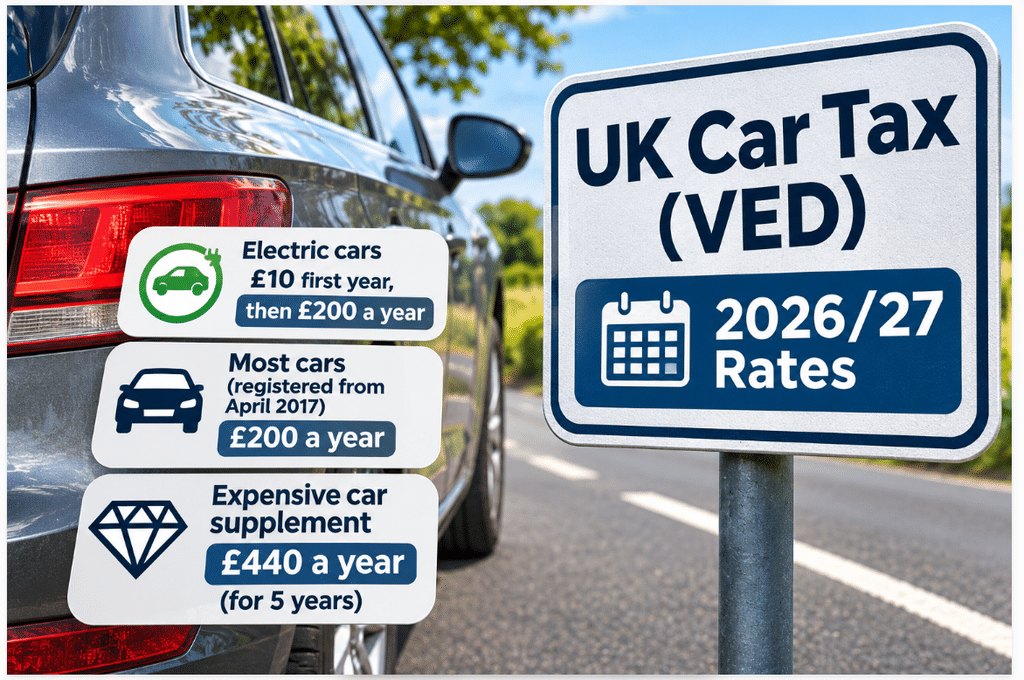
From 1 April 2026, the standard annual car tax rate increased to £200 for most cars registered on or after 1 April 2017. Electric vehicles are also subject to VED following the removal of their general exemption in April 2025.
Our guide explains the latest 2026/27 UK car tax rates, including petrol, diesel, hybrid and electric vehicles, older car tax bands, the expensive car supplement and how to check or renew your vehicle tax.
UK car tax rates 2026/27 at a glance
- Standard annual car tax: £200 for most cars registered from 1 April 2017.
- New electric cars: £10 in the first year, followed by £200 annually.
- Existing electric cars registered from April 2017: £200 annually.
- Cars registered before April 2017: Annual rates generally depend on their CO2 emissions band.
- Expensive car supplement: An additional £440 annually for five years, starting with the second vehicle tax payment.
- Expensive car threshold: Over £40,000 for most qualifying petrol, diesel and hybrid cars, or over £50,000 for qualifying electric cars registered from April 2025.
- New car first-year tax: Between £10 and £5,690 for most petrol, qualifying diesel, hybrid and electric cars, depending on emissions.
- Monthly Direct Debit: Available, but costs 5% more than the annual rate.
These rates apply from 1 April 2026 to 31 March 2027. Different rates and rules can apply to motorhomes, vans, motorcycles and other vehicle categories.
Want to check your vehicle? Use the official DVLA vehicle tax checker to find its current tax status.
How is UK car tax calculated?
Vehicle Excise Duty is calculated using different systems depending on when a vehicle was first registered.
| First registration date | How road tax is calculated |
|---|---|
| Before 1 March 2001 | Generally based on engine size |
| 1 March 2001 to 31 March 2017 | Based on CO2 emissions bands, with special rules for some vehicles |
| 1 April 2017 onwards | Emissions-based first-year rate, followed by a standard annual rate and any applicable supplement |
The registration date matters because two otherwise similar vehicles can have different annual tax bills if they were first registered under different VED systems.
New car tax rates from 1 April 2026
When a brand-new car is first registered, its initial 12-month VED payment is generally calculated using its CO2 emissions.
Vehicles producing more CO2 usually attract higher first-year charges. Diesel cars that do not meet the Real Driving Emissions 2 (RDE2) standard face higher first-year rates.
The following table shows the first-year VED rates for cars registered from 1 April 2026.
| CO2 emissions (g/km) | Petrol, RDE2 diesel, hybrid and electric | Other diesel |
|---|---|---|
| 0 | £10 | £10 |
| 1–50 | £115 | £135 |
| 51–75 | £135 | £280 |
| 76–90 | £280 | £365 |
| 91–100 | £365 | £405 |
| 101–110 | £405 | £455 |
| 111–130 | £455 | £560 |
| 131–150 | £560 | £1,410 |
| 151–170 | £1,410 | £2,270 |
| 171–190 | £2,270 | £3,420 |
| 191–225 | £3,420 | £4,850 |
| 226–255 | £4,850 | £5,690 |
| Over 255 | £5,690 | £5,690 |
Note: The first-year rate applies when a new car is initially registered. Subsequent tax payments normally use the standard annual rate, with an additional supplement where applicable.
Source: DVLA vehicle tax rate tables.
How much is annual road tax for cars registered after April 2017?
For most cars first registered on or after 1 April 2017, the annual standard VED rate is £200 from the second tax payment onwards.
This generally applies to petrol, diesel, hybrid and electric cars, although the expensive car supplement may increase the amount payable.
| Payment method | 2026/27 cost |
|---|---|
| 12 months, single payment | £200 |
| 12 months, annual Direct Debit | £200 |
| 12 monthly Direct Debit payments | £210 total |
| 6 months, single payment | £110 |
| 6 months, Direct Debit | £105 |
Paying monthly or every six months costs more overall than paying annually. If you can afford the annual payment, it is normally the cheapest option.
Do electric cars pay road tax in 2026?
Yes. Electric cars are no longer generally exempt from Vehicle Excise Duty. The change took effect on 1 April 2025 and applies to both new and existing electric vehicles.
The amount depends on when the vehicle was first registered.
| Electric car registration date | 2026/27 VED |
|---|---|
| 1 April 2025 onwards | £10 first year, then £200 annually |
| 1 April 2017 to 31 March 2025 | £200 annually |
| 1 March 2001 to 31 March 2017 | £20 annually |
Some electric cars registered from April 2025 may also pay the expensive car supplement if their original list price exceeded the relevant threshold.
Electric cars registered before 1 April 2025 are not subject to that supplement under the current rules.
For more information, visit the government’s electric vehicle tax guidance.
Do hybrid cars pay road tax?
Yes. Hybrid vehicles are subject to Vehicle Excise Duty, and the amount depends on when the vehicle was registered.
For hybrid cars registered from 1 April 2017, the standard annual rate is £200. New hybrids also pay a first-year rate based on their CO2 emissions.
The previous £10 annual discount for hybrid and alternative-fuel vehicles was removed from April 2025.
Hybrid cars registered before April 2017 generally continue to use the older CO2-based tax bands.
What is the expensive car tax supplement in 2026?
The expensive car supplement, sometimes called the luxury car tax, is an additional annual VED charge for qualifying vehicles with a higher original list price.
For 2026/27, the supplement is £440 per year on top of the standard £200 rate, bringing the annual total to £640.
It is payable for five years, starting from the second time the vehicle is taxed. After the supplement period ends, the vehicle normally returns to the standard annual rate.
Which cars pay the expensive car supplement?
- Petrol, diesel and hybrid cars: Generally, qualifying cars with an original list price of more than £40,000.
- Electric cars registered from 1 April 2025: Those with an original list price of more than £50,000.
- Electric cars registered before 1 April 2025: Exempt from the expensive car supplement under the current rules.
The threshold is based on the car’s original published list price before discounts, not the amount paid for it or its current second-hand value.
Example: car with a £45,000 original list price
Consider a qualifying petrol car first registered from April 2017 with an original list price of £45,000.
- First year: Emissions-based VED rate.
- Years two to six: £640 annually at 2026/27 rates, comprising £200 standard VED and the £440 supplement.
- From year seven: Standard VED only, subject to the rate applicable at the time.
These figures illustrate the 2026/27 rates rather than predicting what tax will cost in future years.
Road tax bands for cars registered before 1 April 2017
Cars first registered between 1 March 2001 and 31 March 2017 generally remain within the older CO2-based road tax system.
Unlike most newer vehicles, their annual tax is determined by emissions bands, meaning lower-emission cars can still have a considerably lower annual tax bill.
However, the annual charges have changed since 2017. The following are the 2026/27 rates for the standard emissions-based bands.
| VED band | CO2 emissions (g/km) | Annual rate 2026/27 |
|---|---|---|
| A | Up to 100 | £20 |
| B | 101–110 | £20 |
| C | 111–120 | £35 |
| D | 121–130 | £170 |
| E | 131–140 | £200 |
| F | 141–150 | £225 |
| G | 151–165 | £275 |
| H | 166–175 | £325 |
| I | 176–185 | £360 |
| J | 186–200 | £410 |
| K | 201–225 | £445 |
| L | 226–255 | £760 |
| M | Over 255 | £790 |
Important: Band K also includes certain cars emitting over 225g/km that were registered before 23 March 2006. Some alternative-fuel and specialist vehicle categories have different rates.
Owners of older low-emission cars should note that the previous £0 rate for Band A has increased to £20 annually.
How much is road tax for cars registered before March 2001?
Cars first registered before 1 March 2001 generally use an engine-size-based tax system rather than the newer CO2 emissions bands.
The rate depends on whether the engine capacity is above or below 1,549cc. Some vehicles may qualify for the historic vehicle tax exemption.
Check the official DVLA rate tables for the amount applicable to your vehicle.
Is it cheaper to buy a car registered before April 2017?
It can be, particularly if you choose a low-emission vehicle that remains within one of the lower pre-2017 tax bands.
For example, a qualifying petrol car registered in March 2017 with emissions of 99g/km would generally fall into Band A, attracting £20 annual VED in 2026/27.
A comparable petrol car registered in April 2017 would generally be subject to the £200 standard annual rate from its second tax payment onwards.
That is a difference of £180 per year at current rates.
However, road tax is only one part of the cost of owning a vehicle. Fuel economy, insurance, servicing, maintenance, depreciation and possible clean-air-zone charges should also influence your decision.
Does road tax change when you buy a used car?
The vehicle’s VED classification generally stays linked to its original registration date and technical details, even when it changes ownership.
However, vehicle tax itself does not transfer to a new keeper.
If you buy a used car, you must tax it before driving it on a public road, even if the previous owner had already paid for several months of tax.
The seller should notify DVLA of the change of keeper. Any refund due to the previous keeper is normally calculated using the remaining full months of tax.
How to check if your car is taxed
You can check whether a vehicle is currently taxed using the free DVLA online service.
- Visit GOV.UK’s vehicle tax checker.
- Enter the vehicle registration number.
- Confirm the vehicle details.
- View the current tax status and expiry information.
You can also check your vehicle’s MOT status and other useful information before a journey.
Read our guide to checking road tax, MOT and driving licence details online.
How do I renew or pay my car tax?
You can tax your vehicle online through GOV.UK, by telephone or at a participating Post Office.
To renew online, you will normally need the reference number from your V11 vehicle tax reminder, your V5C log book or another eligible registration document.
Visit the official vehicle tax payment service to complete the process.
You can usually choose between an annual payment, six-month payments or monthly Direct Debit. Monthly and six-month payment options carry an additional charge.
What happens if you do not tax your car?
It is a legal requirement to tax a vehicle used or kept on a public road unless a valid exemption applies.
Driving or keeping an untaxed vehicle on a public road can lead to enforcement action, including penalties, clamping or removal of the vehicle.
If you are keeping a vehicle off the public road and do not intend to use it, you can make a Statutory Off Road Notification (SORN).
A vehicle with a SORN must not be used or kept on a public road except in limited permitted circumstances.
Find out more about declaring a vehicle off the road.
Which vehicles are exempt from road tax?
Some vehicles qualify for exemption from paying Vehicle Excise Duty.
- Historic vehicles: Qualifying vehicles built before 1 January 1986 can be exempt under the rules applying from April 2026.
- Vehicles used by disabled people: Eligible motorists may qualify for an exemption or reduction, depending on their circumstances.
- Certain specialist vehicles: Some agricultural, mobility and other qualifying vehicle categories may be exempt.
Even if a vehicle is exempt from paying VED, it generally still needs to be registered and taxed in the appropriate tax class.
Check the government’s vehicle tax exemption guidance for eligibility and application details.
UK car tax frequently asked questions
How much is road tax in 2026?
The standard annual VED rate for most cars registered from 1 April 2017 is £200 in 2026/27. Older vehicles may pay different rates based on their emissions or engine size.
Is car tax going up in 2026?
Yes. The standard annual VED rate increased from £195 in 2025/26 to £200 in 2026/27. Many emissions-based bands and first-year rates also increased.
Do electric cars pay road tax now?
Yes. Since April 2025, electric cars have generally been subject to VED. In 2026/27, most electric cars registered from April 2017 pay £200 annually after their first year.
Do hybrid cars get cheaper road tax?
Not automatically. The previous £10 alternative-fuel discount has been removed. Most hybrids registered from April 2017 pay the standard £200 annual rate, although their first-year rate depends on emissions.
What is the £40,000 car tax rule?
Qualifying petrol, diesel and hybrid cars with an original list price above £40,000 generally pay an additional £440 per year for five years, beginning with their second tax payment. A £50,000 threshold applies to qualifying electric cars registered from April 2025.
Does the expensive car supplement apply to second-hand cars?
Yes, where the vehicle is still within its five-year supplement period. The charge is based on the original list price, not the amount paid by the second-hand buyer.
Are cars registered before 2017 cheaper to tax?
Some are. Lower-emission vehicles registered before April 2017 can have significantly lower VED than newer cars. However, higher-emission older vehicles may be more expensive to tax.
Do I need to tax a car that is not being driven?
If a vehicle is kept on a public road, it normally needs to be taxed. If it is kept entirely off the public road, you can declare it SORN instead of paying vehicle tax.
Can I pay road tax monthly?
Yes. Monthly Direct Debit is available for many vehicles, although it costs 5% more than the annual payment. A £200 annual tax bill therefore costs £210 when paid in monthly instalments.
Does road tax transfer when I sell my car?
No. Vehicle tax does not transfer to a new keeper. The buyer must arrange their own tax before using the vehicle on a public road.
Can I drive a car home after buying it without tax?
Generally, no. You should tax the vehicle before driving it on a public road. The previous keeper’s tax does not transfer with the car.
Is road tax the same as a congestion charge or clean air zone charge?
No. Vehicle Excise Duty is a national vehicle tax. Congestion charges, tolls and clean air zone charges are separate payments that may apply when driving in particular areas.
Useful government resources
- Official DVLA vehicle tax rate tables
- Check whether a vehicle is taxed
- Tax or renew your vehicle tax
- Electric and low-emission vehicle tax rules
- Vehicle tax exemptions
- Declare a vehicle off the road (SORN)
More useful motoring guides
Before your next journey, make sure your vehicle’s road tax, MOT and insurance are up to date.
Read our guide to checking your road tax, MOT and driving licence information online.
You can also find out how Dartford Crossing charges work and what to do if you forget to pay.
Last reviewed: 9 November 2026. Rates shown apply to the 2026/27 tax year. Vehicle tax rules and charges can change, so always check the latest DVLA information before making a payment or purchasing a vehicle.